

From left: Stephen Salera, Montgomery County Community College Coordinator of Public Services Training Programs for the Municipal Police Academy, Alex Mann and Nicole Callahan, MCCC Manager of Disability Services. Since 2020, Mann has taught cadets in the Academy about how to interact with individuals on the autism spectrum. Photo by Eric Devlin
Alex Mann stood inside Montgomery County Community College’s Municipal Police Academy teaching the next generation of police officers the same lessons he’s been giving to officers nationwide for nearly a decade: how to interact with individuals on the autism spectrum.
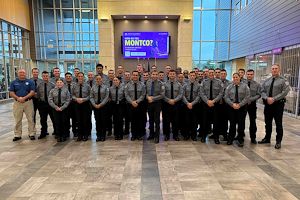 “If you’ve met someone with autism,” he told a classroom of about 30 cadets inside
the College’s Health Sciences Center, “you’ve met one person with autism.”
“If you’ve met someone with autism,” he told a classroom of about 30 cadets inside
the College’s Health Sciences Center, “you’ve met one person with autism.”
Mann, 26, of Malvern, was diagnosed with Level 1 autism spectrum disorder. He began advocating for individuals with the lifelong neurological condition eight years ago, lecturing officers on how to speak to people on the autism spectrum in a manner that deescalates tension and reinforces safety for all involved.
Since he’s begun this work, he has visited more than 500 police departments and trained officers from coast to coast, including across New Jersey and Pennsylvania and as far west as California.
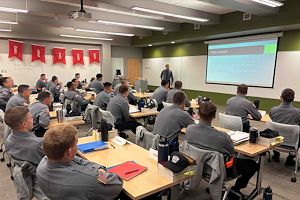 “It was during the pandemic that the education piece really took off,” said Mann.
“In the Amtrak police department, there’s a sergeant there who invited me to do my
first presentation at Temple University’s Ambler Campus. That’s how it really started.”
“It was during the pandemic that the education piece really took off,” said Mann.
“In the Amtrak police department, there’s a sergeant there who invited me to do my
first presentation at Temple University’s Ambler Campus. That’s how it really started.”
The majority of Mann’s visits to police departments are paid for out of his own pocket, though MCCC compensates him as an instructor.
Stephen Salera, MCCC Coordinator of Public Services Training Programs for the Municipal Police Academy, first met Mann when he was working as an officer in the Lower Merion Police Department. Since 2020, Salera has invited Mann to speak twice a year to each new class of cadets.
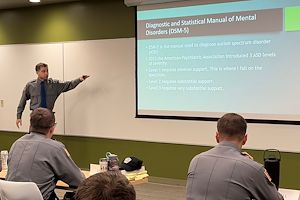 “He teaches our cadets things to be on the lookout for,” he said. “So, when they become
police officers, and they’re out on the street and dealing with people with autism,
they know how to react and interact with them.”
“He teaches our cadets things to be on the lookout for,” he said. “So, when they become
police officers, and they’re out on the street and dealing with people with autism,
they know how to react and interact with them.”
Mann’s lecture includes common triggers for individuals on the spectrum, including loud noises or flashing lights, like the ones found on a police car. Mann told the cadets he used to be afraid of fire alarm systems because of how overstimulating they can be but took time to learn about how they’re designed to help overcome his fear. He now collects alarm systems at his home as a hobby.
Mann also showed cadets an informational card he helped design with the Pennsylvania State Police, which identifies an individual’s autism diagnosis, shares personal details including their name and emergency contact information, and guides law enforcement on best ways to handle the situation. Mann said the card can alert officers that a person with autism may be nonverbal, sensitive to loud noises, tactile-defensive or unresponsive to commands.
“We appreciate him immensely,” said Municipal Police Academy Director Georgette Hill. “He loves coming in and talking to cadets. It’s been a huge help, and we receive great feedback from cadets. He’s very relatable to the cadets and they love learning from him.”
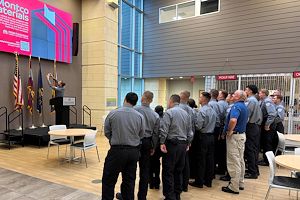 Mann said he enjoys giving his hour-long presentation, which has grown in length over
time and now includes a slideshow, because he feels like he is ensuring future police
officers are learning this information before they step into the field.
Mann said he enjoys giving his hour-long presentation, which has grown in length over
time and now includes a slideshow, because he feels like he is ensuring future police
officers are learning this information before they step into the field.
“Before they’re hired by a police agency, they’re getting that knowledge about what they can expect out on the street,” he said. “It’s beneficial to hear from someone with autism, who deals with it every day, because they’re getting that firsthand experience.”
Mann hoped the cadets left his lecture remembering not to jump to conclusions when encountering an individual who may have autism.
“Be patient, be calm, be understanding and know to take a step back from the assumption that someone may be under the influence or noncompliant,” he said. “Take a step back and realize there may be something else going on. And be prepared to treat a person on the spectrum like you would a close friend or family member.”
“He teaches our cadets things to be on the lookout for. So, when they become police officers, and they’re out on the street and dealing with people with autism, they know how to react and interact with them.” — Stephen Salera, MCCC Coordinator of Public Services Training Programs for the Municipal Police Academy
“Alex did a wonderful job presenting,” said Nicole Callahan, MCCC Manager of Disability Services. “He was very thorough. He gave great scenarios and practical tips for those preparing to enter the field.”
It can be challenging for officers to analyze a situation and understand the different types of individuals they’re interacting with, said Callahan, so Mann’s presentation was very helpful in that regard.
“I hope they came away with at least one or two tips to help them in the future,” she said of the cadets. “A lot of times people with autism may have behaviors that are similar to people who do not have autism. So, to be able to assess the situation, keep calm, remember the tips that Alex was talking about— things like giving them space, allowing them to stim and calm themselves down, will really help the entire situation. It won’t escalate to the next level. Understanding the behaviors of autism really could help the entire situation.”