

Fifteen Montgomery County Community College students in the Sound Recording and Music Technology Department attended the inaugural Muscle Shoals Recording Residency at the FAME and Muscle Shoals Sound Studio Aug. 17-20. Photo by Melissa Miller
Fifteen students from Montgomery County Community College’s (MCCC) Sound Recording and Music Technology (SRT) program recently returned from a once in a lifetime musical experience in Alabama after completing the inaugural Muscle Shoals Recording Residency, an immersive experience that placed students inside two of America’s most historic recording studios—not as tourists, but as participants in professional recording sessions.
From Aug. 17–20, students worked at FAME Recording Studios and Muscle Shoals Sound Studio at 3614 Jackson Highway, Sheffield, Alabama applying what they had learned about recording, engineering, production, songwriting and music history in the rooms where generations of landmark records were created. The studios have recorded some of the music industry’s biggest names from The Rolling Stones to Demi Lovato.
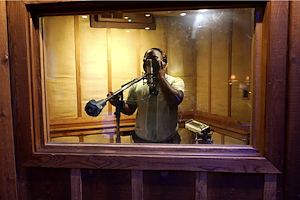 During the Residency, students recorded two original songs written by members of the
student group, working alongside renowned Muscle Shoals musicians Spooner Oldham,
Will McFarlane, Clayton Ivey and Justin Holder, as well as professional studio personnel.
During the Residency, students recorded two original songs written by members of the
student group, working alongside renowned Muscle Shoals musicians Spooner Oldham,
Will McFarlane, Clayton Ivey and Justin Holder, as well as professional studio personnel.
“There are lessons that simply cannot be taught in a classroom. They have to be experienced in the studio—in real time,” said SRT Director David Ivory, a Grammy-nominated producer and engineer, who organized the Residency. “We didn’t want our students standing behind a rope looking at where records were made. We wanted them on the other side of the glass, making records themselves.”
Before joining MCCC, Ivory founded Iris Sound Studios, an innovative geodesic recording facility recognized as Philadelphia's Studio of the Year. He later spent a decade as an independent producer and engineer at Philadelphia's legendary Sigma Sound Studios, where he became part of the city's groundbreaking Neo Soul movement. There, he worked alongside many of the artists, musicians, producers, and engineers who helped redefine contemporary soul and R&B, earning a Grammy nomination for his work on “Things Fall Apart” by The Roots, as well as a Grammy Certificate recognizing his engineering contribution to the Grammy award-winning recording of "You Got Me" featuring Erykah Badu.
From Music History to Making Music
For MCCC students who studied the history and recording traditions of places like Muscle Shoals in the classroom, walking into FAME and Muscle Shoals Sound was powerful.
Then the sessions started.
Students worked shoulder-to-shoulder with studio professionals to record music and sound, set up equipment, develop arrangements and evaluate performances. Ivory said students learned that making a great record requires more than technical knowledge.
“It requires listening, communication, musicianship, collaboration,” he said, “and creative decision-making.”
Students also watched accomplished session musicians encountered original songs they had never heard before and began building arrangements in real time.
SRT student Shaun Brown studied Stax Records and the Memphis Sound in MCCC’s SRT 159 course. Months later, he was hearing musicians connected to that musical tradition play on his own composition.
“Spooner played with so many of my favorite artists and because of the Residency I not only met him, but he played on my own song,” said Brown. “The same with Clayton Ivey. Getting to sit with him and talk, hear about sessions for iconic songs from his perspective, and watch him work taught me so much.”
“Watching them approach musical ideas, listen, and arrange in real time taught me so much just from two sessions,” he continued. “Recording my song at FAME Studios with Oldham and Ivey is something I will remember forever.”
Two Original Songs, Two Historic Studios
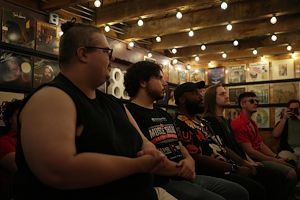 Rather than reproducing famous Muscle Shoals recordings, students brought their own
music into these historic rooms. Student songwriters heard their compositions evolve
as professional musicians developed parts around them, while recording students participated
in the engineering and production decisions needed to capture the performances.
Rather than reproducing famous Muscle Shoals recordings, students brought their own
music into these historic rooms. Student songwriters heard their compositions evolve
as professional musicians developed parts around them, while recording students participated
in the engineering and production decisions needed to capture the performances.
For student Zach Wheitsel, a defining moment came while watching Oldham sit at the Wurlitzer (the same instrument used in the classic hit by Aretha Franklin, "I Never Loved Another Man") to play on a classmate’s original song.
“The moment I will remember most is watching Spooner Oldham play the Wurlitzer piano for my good friend Shaun’s original song,” said Wheitsel. “I was so honored to be in the room for this, and to say that I am beyond happy for my friend to have had this experience would be selling my feelings short.”
For student Jakob Seeds, the experience produced an equally important realization: they belonged in the room.
“It truly felt like I was recording with the Swampers like it was any other day,” said Seeds. “Having confidence in myself as an engineer, speaking with the seasoned local musicians, and exercising my communication and problem-solving skills with my classmates made the moment feel like I was where I was meant to be, doing what I love.”
That sense of belonging was an important part of the Residency. FAME and Muscle Shoals Sound carry extraordinary history, but they remain in places where musicians walk through the doors with songs and ideas and leave with records.
“We wanted the students to understand the history but also realize that history was made because people walked into these rooms with songs and ideas and took chances,” Ivory said. “That’s exactly what we wanted our students to do.”
What Comes Next
The inaugural Muscle Shoals Recording Residency was designed as the beginning of an ongoing experiential-learning opportunity for MCCC students, and planning is already underway for the next Residency and working to expand experiential-learning opportunities for students in the SRT program.
Your support of the MCCC (PA) Legacy Fund can help make that experience possible. Donations can help provide students with opportunities they may not otherwise have access to — including travel, lodging and transportation, professional studio time, and collaboration with session musicians and industry professionals.
Whether you choose to be a sponsor of the future Residency, support our students’ experiences, or make a gift of any size, your generosity can help put SRT students where learning truly comes to life: in the studio, alongside working professionals, gaining the experience and connections that can shape their futures.
“This first Residency showed us what’s possible,” Ivory said. “Now we want to build on it and give another group of students this opportunity. This wasn’t just about learning how records were made in Muscle Shoals. It was about giving our students the chance to discover what they’re capable of making themselves.”
For student Brett Mitchell, the impact was already clear: “I will always have this experience that I can take with me for the rest of my life,” he said. “I will make decisions differently based on what I have learned on this trip. I will always remember this trip.”
MCCC’s Sound Recording and Music Technology (AAS) program provides students with a comprehensive education in sound recording, music production, and music technology comparable to the first two years of study at a conservatory or university. Taught by active music and entertainment industry professionals, the program offers valuable real-world insights and networking opportunities. Students learn in state-of-the-art recording studios and labs at the Blue Bell and Pottstown campuses, gaining hands-on experience with professional-grade equipment. The Blue Bell campus hosts a cutting-edge professional mixing suite with a Solid-State Logic SSL 9000k 56 input console as well as the latest in Dolby Atmos mixing on a Genelec 7.1.4 system. The program emphasizes experiential learning across all aspects of recording and production, preparing students for careers in the audio and music industries.